An n8n AI content pipeline for a crypto market portal
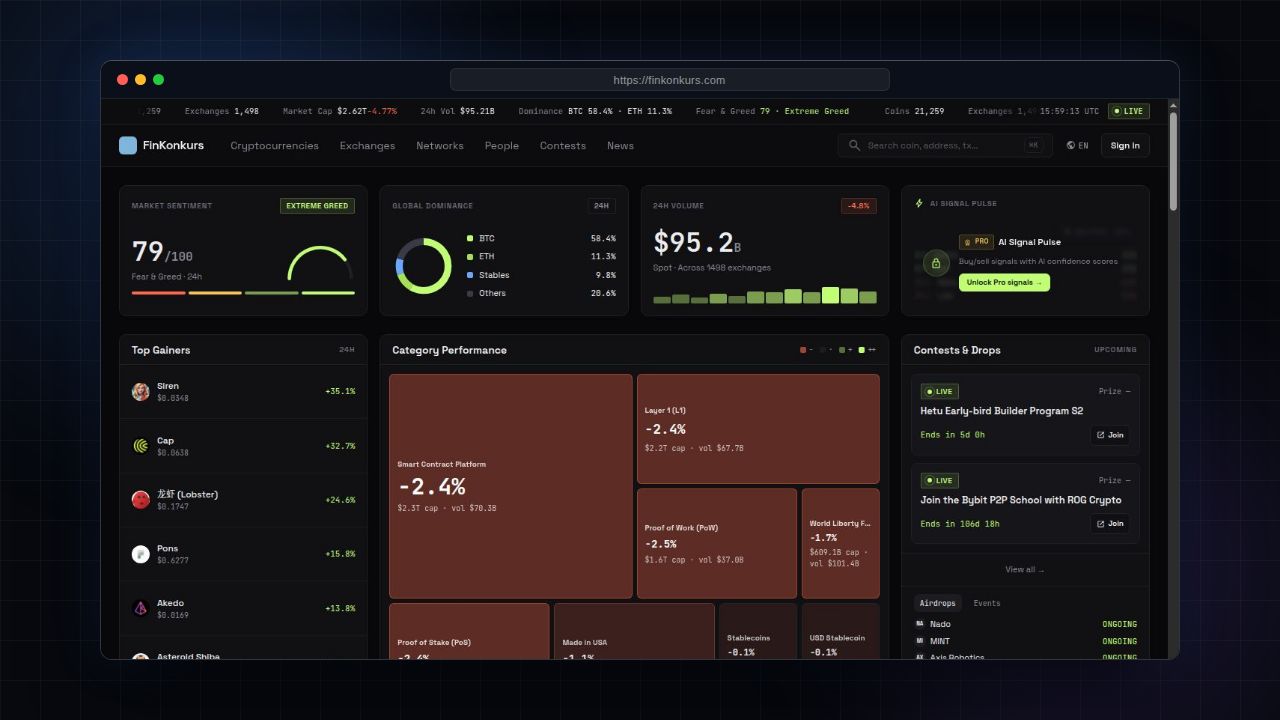
Finkonkurs publishes a page for every cryptocurrency, exchange and blockchain network it tracks, in English and Russian. This AI content pipeline writes the descriptive part of those pages: a 220–380-word encyclopedia-style entry plus an FAQ, researched from the live web and synthesized by a separate writing model. It runs on a self-hosted n8n instance and is orchestrated by the platform's Laravel backend.
How the pipeline works
- Dispatch — the backend posts to the workflow's n8n webhook with a shared-secret header, the editable prompt, structured facts from the database and a callback URL.
- Input check — the workflow stops for a nameless or unknown entity instead of writing about a generic placeholder.
- Parallel research — three web-grounded passes each own one topic: technology and product; market, ecosystem and regulation; people, funding and incidents.
- Research guard — the run aborts before synthesis if a pass returns rate-limited, unfunded or empty; currencies need all three sources, exchanges and networks at least two.
- Synthesis — DeepSeek, with thinking enabled and no web access, merges the notes into Russian HTML, then writes a Russian FAQ as JSON.
- Translation and cleanup — DeepSeek translates both into English, and a final step strips AI-sounding filler while keeping
[[ placeholder ]]tokens and internal-link markers intact. - Callback — Laravel validates the output against the workflow's rules and writes it to the record.
Placeholders keep volatile values, such as a coin's rank or an exchange's maker fee, out of the prose: the backend renders them from live data at page-view time.
Models and how they changed
The first version, in May 2026, fanned out to GPT-5 and Gemini 2.5 Pro, with DeepSeek Reasoner synthesizing and DeepSeek Chat translating. Days later we added Grok 4.3 as a third researcher and moved Gemini to 3.1 Pro: five models in one run. A reference workflow had also queried Perplexity; we dropped it and tightened the prompts.
Since then the mix has been tuned on cost and reliability:
- Benchmarked research models — Gemini 3 Flash matched 3.1 Pro quality in our comparison at roughly a quarter of the cost; 2.5 Flash was too shallow.
- Dropped GPT-5 where it did not pay — OpenAI web search was about 80% of per-generation cost, so exchange and network descriptions moved to Gemini and Grok with a two-source guard.
- Migrated ahead of a deprecation — before DeepSeek retired its
deepseek-chatanddeepseek-reasonernames, all 12 call sites moved todeepseek-v4-flashwith explicit thinking flags and a larger output budget. - Same design, one provider — when the other research providers became unavailable, all three passes moved to Grok with their specialized prompts intact instead of collapsing into one generic query.
Beyond descriptions
The same backend-to-n8n contract runs people research, where Grok identifies the people behind a project and builds a dossier for each that DeepSeek translates, plus news and contest translation. When the person is already known, the identify step skips web search; on measured dev runs that cut its cost from $0.16–0.25 of a $0.74 dossier to about $0.02.
Engineering safeguards
- Publish gate — description workflows are seeded as required, so a record cannot go live until its description has succeeded at least once.
- Signed both ways — secret headers on dispatch and on callback; fast workflows answer synchronously, long ones return an execution ID and call back.
- Loud failures — research nodes capture HTTP status, so a 429 or 403 fails the run with a reason instead of producing a stub.
- One payer — only the development stage dispatches paid runs; results go to a shared ledger keyed by source IDs, so production applies the same text without paying again.
- Workflows as code — templates live in git, are baked into the n8n image and re-imported on every start, and an LLM-free stub backs an end-to-end smoke test.
Related work
This pipeline feeds the Finkonkurs crypto market portal. For another production AI pipeline, see Knigopoisk AI audiobooks, and learn more about our AI integration and automation services.